Gasoline vs. Diesel Engines: Which One Is Right for You?
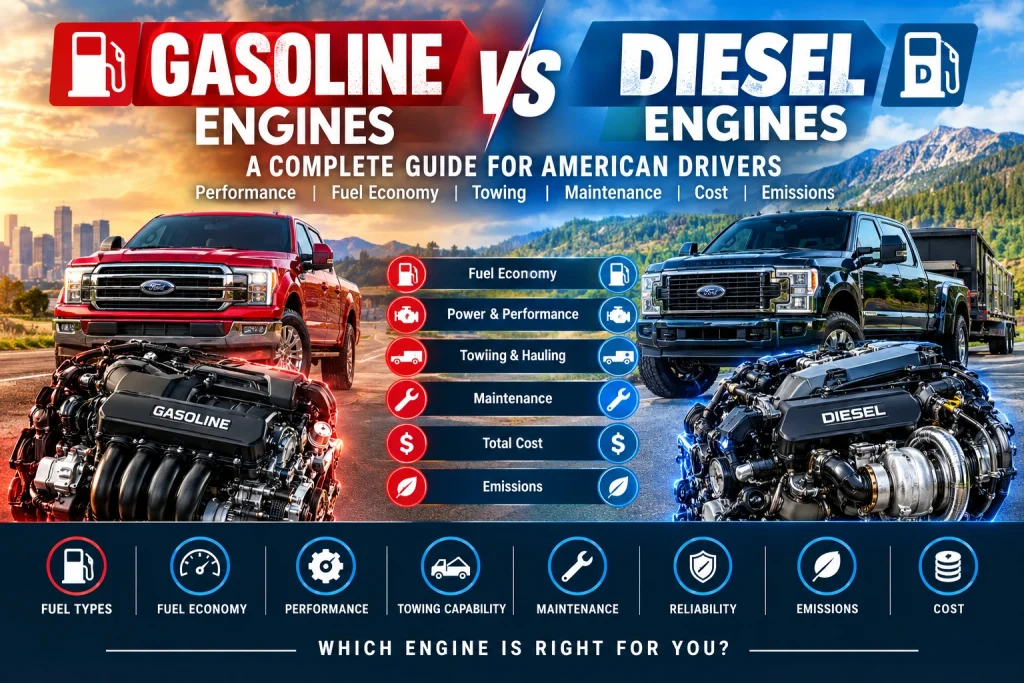
Gasoline vs. Diesel Engines: A Complete Guide for American Drivers
If you’re shopping for a new vehicle, truck, SUV, or work vehicle, one question eventually comes up: gasoline vs diesel engines—which one is better?
The answer isn’t as simple as choosing one fuel over the other.
Gasoline and diesel engines have different strengths. A gasoline engine may make more sense for someone who mainly drives to work, runs errands, takes road trips, and wants lower upfront costs. A diesel engine can be attractive to drivers who regularly tow heavy trailers, haul substantial loads, put a lot of highway miles on their vehicle, or want the characteristics of a diesel powertrain.
Modern engines have also changed dramatically. Today’s diesel vehicles use sophisticated fuel injection, turbocharging, emissions controls, and computerized engine management. Modern gasoline engines have also become highly efficient and technologically advanced.
So, which engine should you choose?
In this guide, we’ll break down gasoline vs diesel engines in plain American English. We’ll compare fuel economy, performance, towing, maintenance, reliability, purchase price, operating costs, emissions, driving experience, and long-term ownership.
Gasoline vs Diesel Engines at a Glance
Before getting into the details, here’s a quick comparison:
| Feature | Gasoline Engine | Diesel Engine |
|---|---|---|
| Fuel | Gasoline | Diesel |
| Ignition | Spark ignition | Compression ignition |
| Typical driving | Daily driving, commuting, SUVs, cars | Heavy-duty work, towing, hauling |
| Fuel economy | Generally good | Often strong, especially under load |
| Low-speed torque | Moderate to strong | Typically very strong |
| Heavy towing | Capable depending on vehicle | Often well suited |
| Maintenance | Generally simpler | Can be more complex |
| Upfront cost | Usually lower | Often higher |
| Fuel system | High-pressure gasoline injection on modern vehicles | High-pressure diesel injection |
| Emissions system | Catalytic converter and related systems | DPF, SCR/DEF, oxidation catalyst and other systems depending on vehicle |
| Cold-weather behavior | Generally straightforward | Can require additional cold-weather considerations |
| Best fit | Everyday drivers | Heavy use and high-load applications |
These are broad characteristics rather than rules for every vehicle. Engine design, vehicle weight, transmission, gearing, emissions equipment, and manufacturer tuning can make a major difference.
What Is a Gasoline Engine?
A gasoline engine is an internal combustion engine that uses gasoline as its fuel.
In a typical gasoline engine, air and fuel are introduced into the combustion chamber. The mixture is compressed, and a spark plug ignites it. The resulting combustion pushes the piston downward, creating mechanical power.
Modern gasoline engines can use technologies such as:
- Direct fuel injection
- Turbocharging
- Variable valve timing
- Cylinder deactivation
- Start-stop systems
- Electronic throttle control
- Variable valve lift
- Sophisticated engine management computers
These technologies allow relatively small gasoline engines to produce substantial power.
For example, a modern turbocharged four-cylinder gasoline engine can provide the performance that once required a much larger naturally aspirated engine.
Why gasoline engines are popular
Gasoline-powered vehicles are extremely common in the United States because they work well for a wide range of everyday driving.
They’re commonly found in:
- Cars
- Crossovers
- SUVs
- Pickup trucks
- Sports cars
- Minivans
- Light-duty work vehicles
For someone who doesn’t regularly tow or haul heavy loads, gasoline can be a practical choice.
What Is a Diesel Engine?
A diesel engine operates differently.
Instead of relying on a spark plug to ignite the fuel-air mixture, a diesel engine compresses air to a high pressure. This compression raises the air temperature. Diesel fuel is then injected into the hot compressed air, causing it to ignite.
In simple terms:
Gasoline engine → spark ignites the mixture
Diesel engine → compression and heat ignite the fuel
This difference in combustion strategy gives diesel engines several characteristics that make them popular for trucks and heavy-duty applications.
Diesel engines are widely used in:
- Heavy-duty pickup trucks
- Commercial trucks
- Delivery vehicles
- Buses
- Construction equipment
- Agricultural machinery
- Mining equipment
- Locomotives
- Marine applications
The EPA notes that diesel fuel is widely used for highway vehicles as well as equipment such as trucks, agricultural and construction machinery, ships, and locomotives.
Gasoline vs Diesel: How Are They Different?
The biggest difference isn’t simply the fuel in the tank.
The engines are designed around different combustion principles.
1. Ignition
Gasoline engines generally use spark plugs.
Diesel engines rely on compression ignition.
That fundamental difference affects engine design, fuel delivery, combustion characteristics, and emissions systems.
2. Torque and Towing
One of the biggest reasons American truck buyers consider diesel is torque.
Torque is the twisting force produced by the engine.
When you’re pulling a heavy trailer up a steep grade, torque becomes particularly important.
Diesel engines are well known for producing strong low-speed torque. This characteristic can make a diesel-powered truck feel confident when pulling:
- Travel trailers
- Boat trailers
- Equipment trailers
- Construction equipment
- Heavy cargo
- Large recreational vehicles
However, you shouldn’t judge towing ability based only on engine type.
A truck’s actual towing capability depends on the entire vehicle configuration, including:
- Engine
- Transmission
- Axle ratio
- Cooling system
- Suspension
- Brakes
- Tires
- Chassis
- Vehicle weight
- Manufacturer’s towing rating
A gasoline truck can be an excellent tow vehicle when properly equipped.
3. Fuel Economy
Fuel economy is another major part of the gasoline vs diesel debate.
Diesel engines have historically been known for strong fuel efficiency, particularly when operating under sustained loads.
But real-world fuel economy depends heavily on the vehicle and how it’s used.
For example, consider two drivers.
Driver A
- Drives 8 miles to work
- Mostly city traffic
- Rarely carries heavy loads
- Doesn’t tow
- Drives relatively few miles per year
A gasoline vehicle may make a lot of sense.
Driver B
- Drives 30,000 miles per year
- Frequently travels on highways
- Regularly pulls a heavy trailer
- Carries equipment
- Keeps the vehicle for many years
A diesel may become more attractive because of its operating characteristics.
The important point is that diesel doesn’t automatically mean lower total ownership cost.
You have to consider fuel prices, purchase price, maintenance, insurance, repairs, and how many miles you drive.
4. Maintenance Costs
This is one area where gasoline and diesel ownership can feel very different.
A modern gasoline engine generally has a relatively straightforward maintenance schedule.
Typical maintenance can include:
- Engine oil changes
- Oil filter replacement
- Engine air filter replacement
- Spark plug replacement
- Transmission service
- Coolant service
- Brake maintenance
- Tire rotation
- Battery replacement
Diesel engines also require routine maintenance, but some systems can add complexity.
Depending on the vehicle, diesel maintenance may include:
- Engine oil and filter service
- Fuel filter replacement
- Diesel exhaust fluid (DEF)
- DPF-related service
- Emissions system maintenance
- Turbocharger-related components
- Glow plug systems
- High-pressure fuel system components
Modern diesel vehicles use advanced emissions-control equipment. The EPA describes technologies such as diesel particulate filters and oxidation catalysts as important emissions-control technologies for diesel engines.
This doesn’t mean every diesel vehicle will be expensive to maintain. It means there’s generally more equipment that may require attention.
5. Diesel Particulate Filters and Modern Diesel Engines
If you’re considering a modern diesel truck, you need to understand the diesel particulate filter, commonly called a DPF.
A DPF is designed to capture particulate matter from diesel exhaust.
The accumulated material can be burned during a process called regeneration.
The EPA explains that DPF systems trap particulate matter and use regeneration to combust the collected material.
This is important because modern diesel ownership is different from owning an older diesel pickup.
Older diesel trucks are often associated with simple mechanical systems and visible exhaust smoke.
Modern diesels are much more sophisticated.
They may use:
- DPF
- Diesel oxidation catalyst
- Selective catalytic reduction
- DEF
- NOx sensors
- Exhaust temperature sensors
- Electronic controls
- EGR systems
These systems help modern diesel engines meet emissions requirements, but they also add complexity.
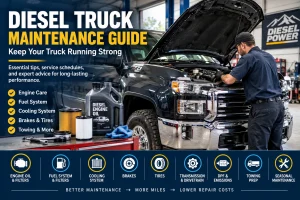
Diesel Truck Maintenance Guide: A Complete Guide for U.S. Truck Owners
6. What Is DEF?
Many modern diesel vehicles use Diesel Exhaust Fluid, commonly called DEF.
DEF is not diesel fuel.
It’s a separate fluid used by certain emissions systems to help reduce nitrogen oxide emissions.
A vehicle equipped with a DEF system has a separate DEF tank.
Never put DEF into the diesel fuel tank.
Likewise, diesel fuel should never be added to the DEF tank.
If you’re buying a modern diesel pickup, it’s important to understand what the vehicle’s emissions system requires before you start driving it.
Gasoline vs Diesel: Which Engine Lasts Longer?
There’s a common belief that every diesel engine will automatically last longer than every gasoline engine.
That’s too simplistic.
Engine lifespan depends on:
- Design
- Manufacturing quality
- Maintenance
- Oil quality
- Driving habits
- Operating temperatures
- Load
- Towing frequency
- Service history
- Fuel quality
- Maintenance intervals
A well-maintained gasoline engine can provide many years of dependable service.
A properly maintained diesel engine can also provide a very long service life.
The key isn’t simply choosing diesel.
Maintenance matters.
A neglected diesel engine can become extremely expensive to repair, while a well-maintained gasoline engine can remain reliable for a long time.
Gasoline vs Diesel for Daily Driving
For the average American driver, daily driving may be one of the most important considerations.
If your normal routine looks like this:
- Work commute
- Grocery shopping
- School runs
- Weekend trips
- Occasional highway travel
- No heavy towing
A gasoline-powered vehicle may provide everything you need.
Gasoline vehicles are available in virtually every segment, and there are many options for drivers who prioritize:
- Lower purchase price
- Smooth acceleration
- Simple ownership
- Quiet operation
- Lower maintenance complexity
A diesel can certainly be used as a daily driver, but if you’re paying extra for diesel capability you rarely use, you should consider whether the additional cost makes sense for your situation.
Gasoline vs Diesel for Towing
This is where diesel engines often become particularly interesting.
If you regularly tow a heavy trailer, a diesel-powered truck can provide strong torque and a powertrain designed around heavy-duty use.
Diesel trucks are especially common among people who tow:
- Fifth-wheel trailers
- Large travel trailers
- Horse trailers
- Heavy equipment
- Boats
- Utility trailers
But there’s another factor to consider: how often you tow.
If you tow a small utility trailer a few times per year, buying a diesel may not be necessary.
If you’re towing thousands of pounds every week, the calculation changes.
Gasoline vs Diesel for Long-Distance Driving
Diesel engines can be appealing for people who spend a lot of time on highways.
Long highway trips allow the engine to operate at a steady load and temperature.
That’s very different from a vehicle that spends most of its time making short trips.
If you’re buying a diesel primarily for highway travel, think about your actual annual mileage.
Someone driving 5,000 miles a year has a very different ownership equation than someone driving 30,000 miles annually.
Gasoline vs Diesel in Cold Weather
Cold weather can affect both types of engines, but diesel engines have some additional considerations.
Diesel fuel can be affected by very cold temperatures, and diesel engines use systems such as glow plugs or intake heating strategies depending on the design.
Modern diesel vehicles are engineered for cold-weather operation, but owners in colder parts of the United States should understand their vehicle’s recommendations for:
- Winter diesel fuel
- Block heaters
- Battery condition
- Glow plug operation
- Fuel filters
- Cold-weather starting
Gasoline engines generally have fewer cold-weather fuel concerns for everyday passenger-car use.
Gasoline vs Diesel: Emissions
Emissions are another important difference.
Both gasoline and diesel engines produce emissions because both burn hydrocarbon-based fuel.
However, their combustion characteristics and emissions profiles differ.
Diesel engines have historically been associated with particulate matter and nitrogen oxide emissions. Modern diesel vehicles use extensive emissions-control systems to reduce these pollutants.
The EPA identifies NOx and particulate matter as important pollutants associated with diesel engines and describes technologies used to control diesel emissions.
Gasoline engines also produce pollutants, including carbon monoxide, hydrocarbons, and nitrogen oxides, and use emissions-control systems such as catalytic converters.
The important takeaway is that modern emissions performance depends on the specific vehicle and its certified emissions-control system, not simply the word “diesel” or “gasoline.”
Which Is Cheaper: Gasoline or Diesel?
There’s no universal answer.
You need to consider the entire ownership equation.
Gasoline can have an advantage because:
- The initial vehicle price may be lower.
- Maintenance can be less complex.
- Spark ignition systems are familiar to most repair shops.
- There are many vehicle choices.
- Diesel-specific emissions equipment isn’t required.
Diesel can potentially make sense because:
- Fuel economy may be strong in certain applications.
- Diesel engines can be well suited to heavy loads.
- High-mileage drivers may benefit from diesel characteristics.
- Heavy-duty towing applications often offer diesel options.
The right comparison isn’t:
“Which fuel is cheaper?”
Instead, ask:
“Which powertrain costs less for the way I actually use my vehicle?”
Gasoline vs Diesel for Pickup Trucks
Pickup trucks make the gasoline-versus-diesel decision especially interesting.
Modern American pickups can be extremely capable with either engine type.
Choose a gasoline pickup if you primarily:
- Commute
- Haul light or moderate loads
- Tow occasionally
- Want lower purchase costs
- Drive relatively few miles
- Prefer simpler ownership
Consider a diesel pickup if you regularly:
- Tow heavy trailers
- Haul heavy loads
- Drive long distances
- Put high mileage on the truck
- Need strong low-speed pulling power
- Plan to keep the truck for many years
The important word is regularly.
Don’t buy a diesel truck just because it sounds more powerful.
Buy it because its capabilities match your workload.
Gasoline vs Diesel: Driving Experience
The two engines can also feel different behind the wheel.
A gasoline engine often feels:
- Smooth
- Responsive
- Quick to rev
- Quiet
- Familiar
A diesel engine often feels:
- Strong at low RPM
- Torque-heavy
- Relaxed under heavy load
- Built around sustained pulling power
Modern turbocharged gasoline engines can also produce impressive torque, so the gap isn’t as simple as it was decades ago.
Transmission technology has also changed the driving experience.
Modern automatic transmissions can keep either engine in an efficient operating range, which means the transmission is just as important to overall performance as the engine itself.
Gasoline vs Diesel Maintenance Checklist
Regardless of engine type, regular maintenance is one of the best ways to protect your investment.
Gasoline engine maintenance
Keep up with:
- Engine oil
- Oil filter
- Air filter
- Spark plugs
- Coolant
- Transmission fluid
- Brake fluid
- Battery
- Belts and hoses
- Tires
Diesel engine maintenance
In addition to general vehicle maintenance, pay attention to:
- Engine oil
- Oil filter
- Fuel filter
- Air filter
- DEF level where applicable
- DPF system
- Warning lights
- Exhaust after-treatment system
- Coolant
- Turbocharger system
- Battery
Always follow the manufacturer’s maintenance schedule for the exact vehicle.
Common Myths About Diesel Engines
Myth 1: Every diesel lasts longer than gasoline
Not necessarily.
Engine life depends heavily on maintenance, design, workload, and operating conditions.
Myth 2: Diesel is always cheaper to operate
Not necessarily.
A diesel may use less fuel in certain applications, but the vehicle may cost more to purchase and maintain.
Myth 3: Diesel trucks are only for commercial drivers
Not at all.
Many private owners use diesel pickups for towing recreational trailers, boats, equipment, and other loads.
Myth 4: Gasoline engines can’t tow heavy trailers
False.
Many gasoline-powered trucks are engineered for substantial towing.
The correct question is whether the specific truck’s towing rating matches your trailer and load.
Myth 5: Modern diesel trucks are just like old diesels
They’re very different.
Modern diesels use sophisticated emissions systems and electronic controls.
Gasoline vs Diesel: Pros and Cons
Gasoline Engine Pros
- Generally lower purchase cost
- Broad vehicle availability
- Smooth operation
- Simple daily-driver application
- Often lower maintenance complexity
- Excellent choice for many commuters
- Strong performance in modern turbocharged applications
Gasoline Engine Cons
- May use more fuel in certain heavy-duty applications
- Generally not the first choice for extremely heavy towing
- Some turbocharged gasoline engines can have complex systems
- High-load fuel consumption can rise significantly
Diesel Engine Pros
- Strong low-speed torque
- Well suited to heavy towing
- Good choice for high-mileage applications
- Common in heavy-duty trucks
- Strong performance under sustained load
- Can be efficient in the right application
Diesel Engine Cons
- Often higher purchase price
- More complex emissions systems
- Fuel-system repairs can be expensive
- DPF/DEF systems require understanding and maintenance
- Not always economical for low-mileage drivers
- Short-trip usage may not suit every diesel application
So, Which Is Better: Gasoline or Diesel?
There isn’t one answer that applies to every American driver.
Instead, start with your actual use case.
Gasoline may make sense if you:
- Drive mostly in the city
- Have a short commute
- Don’t tow frequently
- Want lower initial costs
- Drive relatively low annual mileage
- Want straightforward everyday transportation
Diesel may make sense if you:
- Tow heavy loads frequently
- Drive long distances
- Put high mileage on your vehicle
- Need strong low-speed pulling power
- Use your truck for serious work
- Want a powertrain designed for heavy-duty applications
The best engine is the one that fits the job.
A diesel truck can be unnecessary for someone who only drives to the grocery store and office. On the other hand, a gasoline engine may not be the ideal choice for someone who spends every weekend pulling a large fifth-wheel trailer across the country.
Final Thoughts on Gasoline vs Diesel Engines
The gasoline vs diesel engines debate isn’t really about which fuel is universally better.
It’s about matching the engine to the driver.
Gasoline engines are excellent all-around choices for millions of American drivers. They’re widely available, capable, refined, and well suited to commuting, family transportation, road trips, and many light-duty truck applications.
Diesel engines have a different role. Their strong torque and heavy-duty characteristics make them particularly useful for towing, hauling, commercial work, and high-mileage driving.
Modern diesel engines also come with sophisticated emissions-control equipment. The EPA explains that modern diesel systems can use technologies such as particulate filters and other after-treatment devices to control emissions.
Before buying, don’t focus only on the engine badge.
Look at the complete picture:
Purchase price + fuel costs + maintenance + repairs + annual mileage + towing needs + expected ownership period.
That’s the information that will tell you which powertrain makes sense for your particular situation.
If your vehicle spends most of its life commuting around town, gasoline may provide everything you need.
If you’re regularly pulling a heavy trailer, hauling equipment, or putting serious highway miles on a truck, diesel may be worth considering.
In other words, don’t buy the engine that sounds the toughest—buy the engine that matches the work you actually expect it to do.
Frequently Asked Questions
Is diesel better than gasoline?
Neither is universally better. Diesel engines can be particularly useful for heavy towing, hauling, and high-mileage driving, while gasoline engines can be a practical choice for everyday commuting and lighter-duty use.
Do diesel engines get better gas mileage?
Diesel engines can deliver strong fuel economy in many applications, particularly under sustained loads, but actual fuel economy depends on the vehicle, engine, transmission, driving conditions, and workload.
Are diesel engines more expensive to maintain?
They can be. Modern diesel vehicles may have additional fuel-system and emissions-control components that aren’t found on a comparable gasoline vehicle.
Is a diesel truck worth it for daily driving?
It depends on how you use the truck. If you regularly tow or haul heavy loads and drive many miles, diesel may make sense. If you mostly commute and rarely use the truck’s heavy-duty capability, gasoline may be sufficient.
Which is better for towing, gasoline or diesel?
Both can tow effectively when properly equipped. Diesel engines are often chosen for heavy-duty towing because of their strong low-speed torque, but the vehicle’s specific towing rating should always be the deciding factor.
Do diesel engines last longer?
A well-maintained diesel engine can have a long service life, but longevity depends on engine design, maintenance, operating conditions, and workload. Diesel does not automatically guarantee a longer-lasting vehicle.
What is the biggest difference between gasoline and diesel engines?
The fundamental difference is how combustion begins. Gasoline engines generally use spark ignition, while diesel engines use compression ignition.