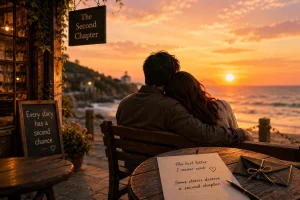
The Last Light on Maple Street: A Story About Second Chances
Search Intent: Informational / Entertainment / Inspirational
The Last Light on Maple Street
At exactly 10:47 every night, the last light on Maple Street came on.
Nobody knew why.
The diner closed at ten.
The grocery store shut its doors at nine.
The little hardware shop had been empty for three years, its dusty windows covered with faded posters.
Even the old church across the street turned off its outdoor lights before midnight.
But at 10:47, one warm yellow light always appeared above the door of a small building at the end of the block.
The sign above it read:
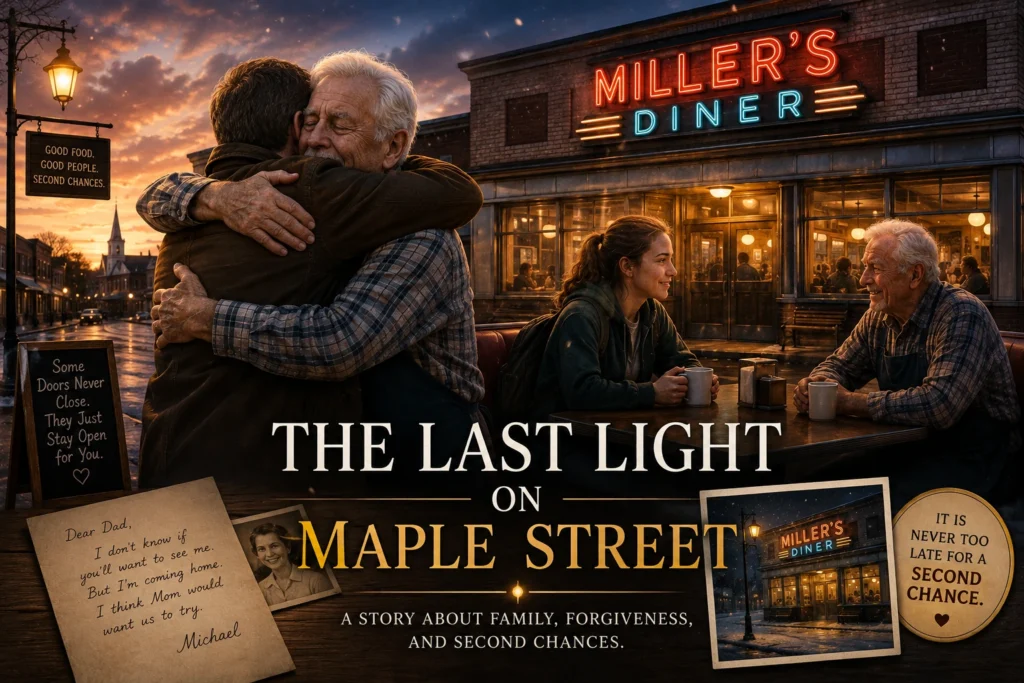
MILLER’S DINER
The paint was peeling. One of the red letters had fallen off years ago, so from a distance it looked like:
MILLER’S D NER
The town of Bellwood, Ohio, had never been famous for anything.
There were no skyscrapers.
No professional sports teams.
No tourist attractions.
No fancy restaurants.
Just quiet streets, old houses, football games on Friday nights, church gatherings on Sundays, and neighbors who knew each other’s business whether they wanted to or not.
And for almost forty years, Miller’s Diner had been part of the town.
But now it was dying.
And so was the man who owned it.
Chapter One: The Man Behind the Counter
Every morning at 5:30, Daniel Miller unlocked the diner.
He was sixty-seven years old, though most people guessed older.
His hair had turned almost completely white. His shoulders leaned slightly forward, and his hands shook whenever he tried to pour coffee into a cup.
Still, he came to work every morning.
He always wore the same dark-blue apron.
He always played the same old country station on the radio.
And he always placed three sugar packets beside every customer’s coffee.
Nobody knew why he did that.
Nobody asked.
Daniel had learned a long time ago that people often carried stories they didn’t want to explain.
He understood that better than most.
At 6:05 one cold Tuesday morning, the bell above the diner door rang.
Daniel looked up.
“Morning, Frank.”
A large man in a construction jacket walked inside.
“Morning, Dan.”
Frank took his usual seat at the counter.
“Coffee?”
“You already know.”
Daniel smiled.
“Decaf?”
Frank stared at him.
“Don’t start.”
Daniel laughed.
For a few minutes, neither man said anything.
The radio played softly in the background.
Outside, snow covered Maple Street.
Frank finally looked around.
“You hear the news?”
“What news?”
“City council meeting.”
Daniel wiped the counter.
“I don’t follow politics.”
“It’s about your diner.”
Daniel stopped moving.
“What about it?”
“They’re talking about redevelopment.”
Daniel’s expression changed.
Frank lowered his voice.
“The building’s been listed as abandoned commercial property.”
Daniel laughed once.
“Abandoned?”
“They don’t know you’re still here.”
Daniel looked around his diner.
The cracked booths.
The old coffee machine.
The faded photographs hanging on the wall.
The counter where his father had once served hamburgers.
“I’ve been here forty years.”
“I know.”
“My father built this place.”
“I know.”
“My wife worked here.”
“I know.”
Daniel looked toward the window.
Snow continued falling.
“So why does everyone keep telling me it’s over?”
Frank didn’t answer.
Because they both knew the truth.
The diner was losing money.
Daniel had spent most of his savings keeping it open.
His wife, Margaret, had died five years earlier.
His son, Michael, had moved to Colorado and hadn’t spoken to him in nearly seven years.
And customers were disappearing.
Bellwood was changing.
People ordered food through apps now.
They grabbed coffee from drive-through windows.
They ate breakfast while sitting in traffic.
Nobody wanted to sit in an old diner and talk anymore.
At least, that’s what Daniel believed.
That morning, after Frank left, Daniel opened a drawer beneath the counter.
Inside was an old photograph.
A young woman stood beside him.
She had dark hair, bright eyes, and a smile that seemed impossible to forget.
Margaret.
Daniel touched the photograph gently.
“I think they’re going to take the place, Maggie.”
He paused.
“And I don’t know what I’m supposed to do after that.”
The diner was silent.
Then the old refrigerator clicked on.
Daniel smiled sadly.
“Yeah.”
He put the photograph back.
“I know.”
Chapter Two: The Girl Who Walked In
At 10:47 that night, Daniel turned on the light above the door.
He didn’t know why he always did it.
Maybe it was habit.
Maybe it was loneliness.
Maybe some part of him still believed someone might walk through the door.
That night, someone did.
The bell rang.
Daniel looked up.
A girl stood in the doorway.
She looked about seventeen.
Her coat was soaked from the snow.
Her hair was messy.
She carried a backpack over one shoulder.
Daniel frowned.
“We’re closed.”
“I know.”
“Then why are you here?”
The girl looked behind her.
Then back at Daniel.
“Can I sit here for a minute?”
Daniel studied her.
“You lost?”
“No.”
“Do your parents know where you are?”
She didn’t answer.
Daniel sighed.
“Sit down.”
She walked toward the counter.
Daniel poured her a cup of hot chocolate.
“I didn’t ask for that.”
“I know.”
She stared at the cup.
“How much?”
“Nothing.”
“I don’t need charity.”
“Good.”
She looked confused.
Daniel pointed toward the cup.
“Then consider it an investment.”
“In what?”
“Your future.”
She almost smiled.
Almost.
“What if I don’t have one?”
Daniel leaned against the counter.
“Everyone has one.”
“That’s easy for you to say.”
“Why?”
“Because you’re old.”
Daniel laughed.
“That’s the first time anyone has used ‘old’ as an argument.”
She finally smiled.
“What is your name?”
“Emily.”
“Emily what?”
“Emily Carter.”
Daniel nodded.
“Nice to meet you, Emily Carter.”
She looked around the diner.
“You’re really open this late?”
“No.”
“Then why is the light on?”
Daniel glanced toward the window.
“I like the light.”
Emily looked at him for a moment.
“That’s not the real reason.”
Daniel raised an eyebrow.
“You know me for thirty seconds and already think you know my secrets?”
“No.”
She looked down at her hands.
“I just think people don’t leave lights on for no reason.”
Daniel didn’t answer.
Because she was right.
Chapter Three: The Letter
Emily came back the next night.
And the night after that.
Soon, she became a regular.
She always arrived around 10:47.
She always ordered hot chocolate.
And she always sat at the same booth near the window.
Daniel never asked why.
One night, Emily noticed the photograph on the counter.
“Who’s that?”
“My wife.”
“Where is she?”
Daniel looked at the photograph.
“She died.”
Emily immediately looked down.
“I’m sorry.”
“Don’t be.”
“Why not?”
“Because she had a good life.”
Emily didn’t understand.
“Isn’t it sad?”
“Of course.”
Daniel smiled.
“But sad and grateful can live in the same house.”
Emily thought about that.
Then she asked:
“Did you love her?”
Daniel laughed.
“More than I knew how to explain.”
Emily smiled.
“My parents don’t even talk to each other.”
Daniel said nothing.
“They live in the same house,” she continued. “They just don’t talk.”
“That’s hard.”
“Yeah.”
She looked out the window.
“Sometimes I think I’d rather live anywhere else.”
Daniel took a deep breath.
“You know what I learned?”
“What?”
“You can run from a place.”
He paused.
“But you can’t always run from what happened there.”
Emily looked at him.
That sentence stayed with her.
Two days later, Daniel found something under the booth where Emily usually sat.
A folded envelope.
He opened it only because he thought it might contain an emergency contact number.
Instead, he saw his own name.
Daniel Miller
His hands began shaking.
Inside was a letter.
Mr. Miller,
I don’t know if you remember me.
My name is Michael Miller.
Daniel stopped breathing.
His son.
Michael.
The boy who had left Bellwood seven years ago.
The boy who had never called.
The boy Daniel had convinced himself didn’t want him anymore.
Daniel continued reading.
I heard they’re planning to close the diner.
I also heard you’re still there every night.
I’m coming home.
I don’t know if you’ll want to see me.
But I’m coming anyway.
Michael
Daniel sat down.
The diner suddenly felt much too quiet.
He read the letter again.
Then again.
At the bottom, there was one more sentence.
I think Mom would want us to try.
Daniel closed his eyes.
For the first time in seven years, he cried.
Chapter Four: Seven Years
Michael had been twenty-nine when he left Bellwood.
He and his father had argued over everything.
Money.
The diner.
His future.
His mother.
Mostly, they argued because they were both grieving.
Margaret had been sick for almost two years.
Daniel wanted Michael to stay.
Michael wanted to leave.
Daniel thought leaving meant abandoning the family.
Michael thought staying meant giving up his life.
One night, they had a terrible argument.
“You don’t care about this family!” Daniel shouted.
Michael shouted back.
“You don’t care about me!”
Those words had changed everything.
Michael packed a bag.
He left that night.
Daniel never stopped him.
And Michael never came back.
Seven years passed.
Seven birthdays.
Seven Christmases.
Seven Mother’s Days.
Seven times Daniel almost called.
But pride is strange.
Sometimes it feels like strength.
Sometimes it feels like protection.
Sometimes it becomes a wall so high that even love can’t climb over it.
Now Michael was coming home.
And Daniel didn’t know whether to be angry or grateful.
Chapter Five: The Town Changes
Three days later, the city council held a meeting.
The plan was simple.
The old section of Maple Street would be renovated.
The diner would be demolished.
A modern retail building would replace it.
There would be new apartments.
A coffee chain.
A pharmacy.
Parking spaces.
Daniel sat in the back of the room.
A developer stood at the front.
“This project will bring jobs and investment to Bellwood.”
People nodded.
Daniel looked around.
He recognized many faces.
People he had fed for decades.
People who had celebrated birthdays in his diner.
People who had cried at his counter.
People who had fallen in love in booth number three.
Nobody spoke.
Then Emily stood up.
She was still wearing her school jacket.
The room became quiet.
“My name is Emily Carter.”
The city council chair looked surprised.
“I’m seventeen.”
A few people smiled.
Emily continued.
“I don’t own a business.”
“I don’t know anything about real estate.”
“And I don’t have a lot of money.”
The room laughed softly.
“But I know what that diner means.”
Daniel stared at her.
Emily took a breath.
“Sometimes people need a place where they don’t have to pretend everything is okay.”
The room became silent.
“I went there when I didn’t know where else to go.”
She looked at Daniel.
“He gave me a cup of hot chocolate.”
“That’s all.”
She smiled.
“But sometimes that’s enough.”
Daniel looked down.
Emily continued.
“If you tear down that building, you’re not just tearing down a restaurant.”
“You’re tearing down a place where people remember who they were.”
Nobody spoke.
Then Frank stood up.
“I’m with the kid.”
Another person stood.
Then another.
An elderly woman raised her hand.
“I met my husband there.”
A man in the back said:
“My father took me there every Saturday.”
A former waitress said:
“I worked there when I was nineteen.”
One story became another.
Then another.
The meeting lasted nearly three hours.
The redevelopment plan wasn’t canceled.
But it was delayed.
And for the first time in years, people were talking about Miller’s Diner.
Chapter Six: The Son at the Door
The next morning, Daniel opened the diner at 5:30.
At 6:02, the door opened.
Daniel looked up.
A man stood there.
He was taller than Daniel remembered.
Short dark hair.
Gray jacket.
A small scar above his left eyebrow.
Daniel knew immediately.
Michael.
Neither man spoke.
Seven years disappeared in a single second.
Michael took one step forward.
“Hi, Dad.”
Daniel’s throat tightened.
“You’re late.”
Michael smiled.
“Seven years.”
“I know.”
Daniel walked around the counter.
For a moment, neither knew what to do.
Then Daniel hugged his son.
It wasn’t a perfect hug.
It wasn’t dramatic.
There were no speeches.
Just two men holding onto each other while everything they had refused to say finally became unnecessary.
Michael pulled away.
“I’m sorry.”
Daniel shook his head.
“I’m sorry too.”
They sat in booth number three.
The same booth where Michael had eaten pancakes as a child.
The same booth where Margaret had once told them they were both being stubborn.
Michael laughed.
“Mom would have loved this.”
Daniel smiled.
“She would have yelled at us first.”
They laughed.
Then they cried.
And for the first time in seven years, they talked.
Not about money.
Not about who was right.
Not about the past.
They talked about Margaret.
They talked about life.
They talked about everything they had missed.
Chapter Seven: The New Sign
Michael stayed in Bellwood.
Not permanently at first.
Just for a few weeks.
Then a few months.
He helped Daniel repair the diner.
They painted the walls.
They replaced broken lights.
They repaired the old coffee machine.
Emily came in after school and helped clean tables.
Frank brought his construction crew.
The elderly woman who had spoken at the council meeting brought homemade pies.
Soon, people started volunteering.
Someone created a Facebook page.
Someone else organized a fundraiser.
A local artist painted a new sign.
It read:
MILLER’S DINER
Underneath were smaller words:
GOOD FOOD. GOOD PEOPLE. SECOND CHANCES.
Daniel stood across the street and looked at it.
“I like it.”
Michael smiled.
“Mom would too.”
Daniel nodded.
Then he looked at the light above the door.
“You know what?”
“What?”
“I think we should keep that.”
“The light?”
“Yeah.”
“Why?”
Daniel smiled.
“Because you never know who’s coming home.”
Chapter Eight: 10:47
Months passed.
The redevelopment project was redesigned.
The diner remained.
Business improved.
But something more important happened.
People returned.
Not because the food was the best in Ohio.
It wasn’t.
Not because the diner looked modern.
It didn’t.
People came because it felt like home.
On Friday nights, teenagers filled the booths.
On Saturday mornings, families came for pancakes.
On Sunday afternoons, older couples sat near the window and shared pie.
Emily graduated high school.
She received a scholarship to a university several hours away.
Before leaving, she visited Daniel.
“I’ll come back.”
Daniel smiled.
“People always say that.”
“I mean it.”
“I know.”
She hugged him.
“Thank you.”
“For what?”
“For leaving the light on.”
Daniel smiled.
“You were the one who walked through the door.”
Emily stepped outside.
She looked back.
The diner sign glowed above her.
For a moment, she remembered the first night she had arrived.
Cold.
Lost.
Angry.
Certain that nobody cared.
Now she knew better.
Sometimes life doesn’t send you a solution.
Sometimes it sends you a person.
Sometimes it sends you a place.
Sometimes it sends you a small light in a dark street.
And sometimes, when you think you have reached the end of your story, life quietly turns the page.
Chapter Nine: The Last Light
Years later, Daniel retired.
Michael took over the diner.
The place changed again.
There was a new menu.
A new coffee machine.
A small bookshelf in the corner.
But the old photograph of Margaret remained above the counter.
So did the light.
Every night at 10:47, Michael turned it on.
One evening, an elderly man walked into the diner.
Michael looked up.
“We’re closed.”
The man smiled.
“I know.”
Michael recognized the words.
His father had said them thousands of times.
The man looked exhausted.
“Can I sit for a minute?”
Michael smiled.
“Of course.”
He poured the man a cup of coffee.
Three sugar packets.
The man looked at them.
“Why three?”
Michael laughed.
“My dad always did that.”
The man smiled.
“Your dad?”
“Yeah.”
“Where is he?”
Michael looked toward the photograph.
“He’s gone now.”
The man nodded.
“I’m sorry.”
Michael shook his head.
“Don’t be.”
“Why?”
“Because he had a good life.”
The man looked at him.
Michael smiled.
“Sad and grateful can live in the same house.”
The man became quiet.
Outside, snow began to fall.
The diner was warm.
The radio played softly.
And above the door, the last light on Maple Street was glowing.
10:47.
Always 10:47.
Because somewhere in the darkness, there was always someone who needed to know that the door was still open.
That somebody was still waiting.
That they weren’t forgotten.
And that it wasn’t too late.
The Lesson of Miller’s Diner
We often imagine that second chances arrive with dramatic announcements.
They don’t.
Sometimes a second chance looks like a phone call you are afraid to make.
Sometimes it looks like an apology.
Sometimes it looks like walking through a door at the exact moment someone decided to leave the light on.
Daniel spent seven years believing his son had forgotten him.
Michael spent seven years believing his father didn’t want him back.
Both were wrong.
The distance between them wasn’t created by a lack of love.
It was created by pride, pain, fear, and silence.
And that is something many families understand.
People don’t always stop loving each other.
Sometimes they simply stop talking.
That’s why the story of Miller’s Diner isn’t really about a restaurant.
It’s about people.
It’s about the conversations we postpone.
The apologies we avoid.
The people we assume have moved on.
And the opportunities we believe have disappeared forever.
But life has a strange way of surprising us.
A letter can change everything.
A cup of hot chocolate can change everything.
A seventeen-year-old girl walking into a closed diner can change everything.
One small light can change everything.
So if there is someone you haven’t spoken to in a long time, don’t automatically assume it’s too late.
If you’ve made a mistake, don’t assume you’re beyond forgiveness.
If you’re struggling, don’t assume nobody cares.
And if you are waiting for someone to come home, perhaps leave a light on.
You never know who might see it.
You never know who might need it.
And you never know when someone will finally find their way back.
Final Thought
At the end of every difficult road, we want to believe there is a bright sunrise waiting.
Sometimes there is.
But sometimes, before the sunrise, all we get is one tiny light in the darkness.
And maybe that’s enough.
Because you don’t need to see the entire road.
You only need enough light to take the next step.
So keep going.
Keep hoping.
Keep the door open when you can.
And when the night gets long, remember the lesson of Miller’s Diner:
It is never too late for a second chance.
And sometimes, the person you are waiting for is closer than you think.